
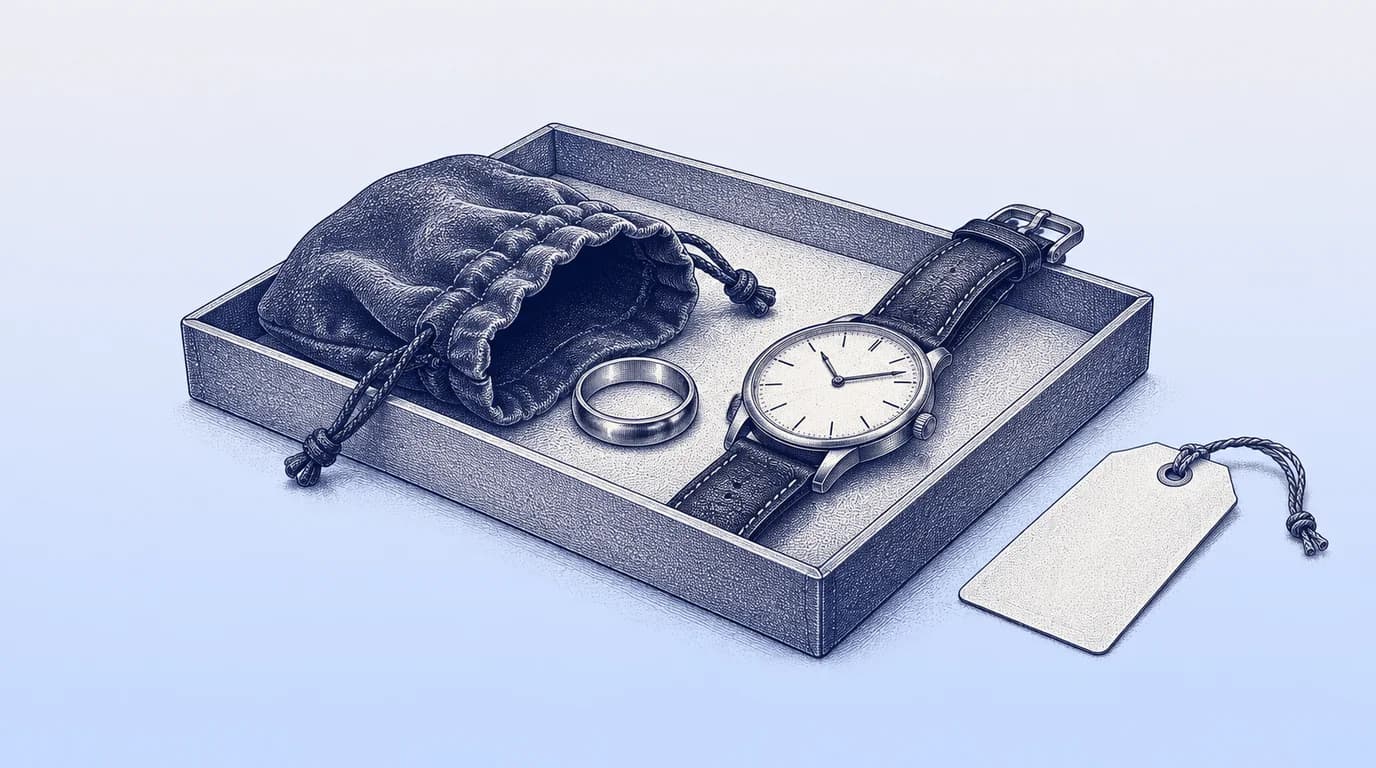
A daughter calls three weeks after the funeral. Her mother was wearing a wedding ring when she died at the nursing home, and it was not in the envelope you gave her. Was it on her mother when your staff collected her? Was it removed before the viewing, or left on for burial? Without a record, nobody knows, and the family will assume the worst. This guide covers what to record, from the moment you take custody to the moment you hand items back. It is general information, not legal advice.
What does the law say about a person’s belongings?
Less than most directors expect. Most of the rules read for this guide deal with belongings at two moments: when the body is removed from the place of death, and when it is delivered for cremation. The table shows examples.
| Where | What the rule requires | Source |
|---|---|---|
| Minnesota | A certificate of removal at the place of death, listing the type and condition of any personal property removed with the body, signed by the person making the removal and, where possible, the person with custody. The funeral establishment keeps it three years | Minnesota Statutes 149A.90, subdivisions 4 and 5 |
| Minnesota | The cremation authorization gives directions for any noncombustible items recovered from the cremation chamber | Minnesota Statutes 149A.95, subdivision 4 |
| Texas | The cremation authorization lists any items of value delivered to the crematory with the body, and how to handle them. A crematory that uses reasonable care is not liable for valuables | Health and Safety Code 716.052(a)(9), 716.203(c) |
| Illinois | The cremation authorization lists items of value delivered with the body, with handling instructions. A crematory is not liable for valuables without written instructions | 410 ILCS 18/20(a)(1)(J), 18/45(e) |
| Ohio | The cremation authorization lists items of value delivered to the crematory, with handling instructions | Revised Code 4717.24(A)(13) |
| Iowa | The cremation authorization lists all items of value and instructions for their disposition | Iowa rule 481-900.10 |
| California | A crematory may remove identifiable dental gold or silver, jewelry or mementos that its equipment cannot process, and returns them to the urn unless the person with the right to control directs otherwise | Health and Safety Code 7051(b) |
| CANA model law | The authorization lists items of value. A crematory is not responsible for items delivered with the body | Model Cremation Law, Parts 4 and 9 |
Two lessons follow. First, the cremation authorization is the one place where several states require belongings to be written down, so treat that line as mandatory everywhere. Second, the crematory’s protection is your exposure: if the crematory is not liable for a ring that arrived on the body, the question becomes who sent the body with the ring on. Minnesota’s certificate of removal is a good model for every state, because it records belongings at the first handoff, with two signatures. For a state’s other rules, see the guides to Texas and California.
What should you record when you take custody?
Everything that comes with the person, at the place of death, before you leave. Ask the nurse, the family or the investigator to check the list with you and sign it. If the death was at a hospital or nursing home, ask whether the facility kept any belongings. The King County Medical Examiner’s office in Washington, for example, says that after a hospital or nursing home death, property is generally held by the facility, and that effects its investigators collect are released to the family’s funeral home. Clothing worn at death goes in a separate bag with the person.
| Field | Example | Why |
|---|---|---|
| Item description | Yellow metal band with one clear stone, left ring finger | Describes without judging value or material |
| Condition | Scratched, stone intact | Prevents a later dispute about damage |
| Where it was | On the body, in a bag from the facility, with the family | Shows how it reached you |
| Clothing | Blue nightgown, white socks | Families often ask for clothing back |
| Released by | Name, title, facility, signature | The other side of the handoff |
| Received by | Your staff member’s name and signature | Who took custody |
| Date, time and place | October 18, 2:14 AM, Room 112 | Fixes the moment custody changed |
| Photos | One photo per valuable item | Shows what the item looked like |
See a signed intake record on a sample case
Write "yellow metal" and "white stone", not "gold" and "diamond". You cannot test either, and a description that names a value invites a dispute about it. Note items that are not there as well: "no rings on either hand" is a useful line when a family later remembers a ring. The first call intake checklist already asks which belongings to collect. Add this record to the removal.
What do you do with items found during preparation?
Treat them as a new custody event. A hearing aid in the ear, a ring under a bandage, cash in a pocket, a medal pinned inside a jacket: each one was not on the transfer record, so it needs a record of its own.
- Stop and call a second staff member to witness.
- Photograph the item where it was found, without photographing the person.
- Describe it the same way as at transfer, and note where it was found.
- Seal it in a numbered envelope or bag, and have both people sign across the seal.
- Add it to the case and tell the family the same day.
- Ask the family what they want done with it, and record the answer.
Do not cut a ring off a finger without the family’s permission, unless your state’s rules or a medical examiner require it. Count cash with two people and write the amount on the envelope. Every step should be traceable in the case’s activity log, so a later question has a dated answer.
How do you ask the family what to do with each item?
Ask at the arrangement conference, item by item, and get the answer in writing on the authorization or a separate form. Families do not always know that what stays on the body at a cremation is destroyed. California’s Cemetery and Funeral Bureau tells families in its consumer guide to remove all valuables, like jewelry or mementos, before their loved one is moved to the crematory. Say the same thing in plain words.
| Instruction | When it applies | What to tell the family |
|---|---|---|
| Return to the family now | Any disposition | You will sign for the items when you collect them |
| Leave on for the viewing, then return | A viewing before cremation or burial | Staff will remove them after the viewing and record it |
| Leave on for burial | Burial or entombment | Items buried with the person cannot be recovered without disinterment |
| Leave on for cremation | Cremation | Most items are destroyed. In California, identifiable dental gold, jewelry or mementos the equipment cannot process may be returned in the urn |
| Send with the person to the crematory | Cremation, under the state’s authorization | The items are listed on the authorization with how to handle them |
Implanted devices are a separate question, covered in pacemakers and implanted devices before cremation. Get the instruction from the person with the right to control disposition. If two relatives want the same ring, do not choose between them: hold the item, and ask for a written agreement. The guide to building a signature packet shows how to add a personal effects form to the documents the family signs.
How should you store belongings while they are in your care?
- Sealed and numbered. One envelope or bag per case, with the case number and the person’s name on it.
- Locked. A safe or locked cabinet with a short list of key holders, not a desk drawer.
- Logged. Every time the envelope is opened, record who, when and why, and reseal it.
- Clothing separate. Clothing worn at death in its own labeled bag, kept apart from valuables.
- Limited photos. Store photos with the case where only the staff who need them can see them, as the guide to role-based access describes.
The same discipline applies to the person and to their belongings. The chain of custody guide explains how to record each handoff.
How should you return items, and who signs?
Return items to the person the family named in writing, usually the person with the right to control disposition. Read the list aloud, check each item against the transfer record and the photos, and have the recipient sign and date the list. A staff member signs as the person releasing them. If an item on the transfer record is not being returned, because it was buried or cremated at the family’s request, say so on the list and point to the instruction.
Some items are not yours to return. The King County Medical Examiner’s office says it does not release weapons or other evidence to families, and that items held for a law enforcement investigation go to the investigating agency. If an investigator or medical examiner took something, record who took it and when, and tell the family whom to ask.
What should you do when a family says something is missing?
Listen first, then go to the record. A family that thinks you lost their mother’s ring is grieving twice. The steps below are suggested practice.
| Step | What to do | Who |
|---|---|---|
| 1. Acknowledge | Thank them, take the details, and promise an answer by a set day | Whoever takes the call |
| 2. Check the record | Transfer record, preparation notes, photos, envelope log, return list | Director on the case |
| 3. Check the facility | Ask the hospital, nursing home or medical examiner what they kept or released | Director on the case |
| 4. Search | Removal vehicle, cot, preparation room, clothing bags, storage | Two staff members |
| 5. Report | Tell the family what the record shows, in person or by phone | Owner or manager |
| 6. Escalate | If the record shows the item was in your care and is gone, call your insurer and attorney | Owner |
Do not guess, and do not blame the facility or the family. If the record shows the ring was never received, show the family the signed transfer list and the photos. If it shows the ring was received and cannot be found, say so honestly and involve your insurer. The guide to audit trails explains why a record that cannot be edited after the fact carries weight in that conversation, and the guide to online reviews covers how to answer a public complaint.
Should you photograph personal effects?
Yes, the items, never the person. A photo of a ring on a cloth with the case number beside it settles more arguments than any description. Take photos at transfer for valuables, at preparation for anything found, and at return for anything the family disputes. Use a firm device, not a personal phone, and store the photos with the case. Delete nothing until the case is closed and your retention period has passed, as the recordkeeping checklist sets out.
How FuneralHQ handles this
In FuneralHQ, the case record has a personal effects field for jewelry, clothing and anything else received with the person. A removal can be recorded through the signed, timestamped intake form on the chain of custody portal. A document template can fill in the personal effects list from the case, so a release form goes to the family for e-signature with the list already on it, and the signed copy is stored on the case.
Common questions about personal effects
Should jewelry be removed before cremation?
Unless the family has asked in writing for it to stay on. California’s Cemetery and Funeral Bureau tells families to remove all valuables before the body is moved to the crematory. In California, a crematory may return identifiable dental gold, jewelry or mementos its equipment cannot process to the urn, but other items are lost.
Who is entitled to receive the belongings?
Usually the person with the right to control disposition, or whoever they name in writing. Ownership of valuable items can be an estate question, so if relatives disagree, hold the items and ask for a written agreement or advice from the estate’s attorney.
Does the FTC Funeral Rule cover personal effects?
Not in the FTC’s guide, Complying with the Funeral Rule, which covers price lists, required disclosures, telephone price questions and misrepresentations, and does not mention belongings. The rules that mention belongings are state rules, such as Minnesota’s certificate of removal and the items-of-value line on cremation authorizations in Texas, Illinois, Ohio and Iowa.
How long should we keep the personal effects record?
At least as long as your state requires for the related record. Minnesota keeps the certificate of removal three years. Keeping the effects record with the case for your full case retention period is the safer practice.
What if nobody collects the belongings?
Send written notices you can prove, as you would for unclaimed cremated remains, and ask your attorney what your state allows before you dispose of anything. Keep the items sealed and logged in the meantime.
Can a crematory be held responsible for a lost ring?
It depends on the state and the paperwork. Texas section 716.203(c) protects a crematory that uses reasonable care with valuables, and Illinois section 18/45(e) protects one that received no written instructions about them. CANA’s model law says the crematory is not responsible for items delivered with the body.
Should the family sign when they receive items?
Yes. A signed and dated list, checked item by item against the transfer record, is the end of your custody of those items. Without it, you cannot show they were returned.
What about items the medical examiner kept?
Record what the examiner or investigator took, and tell the family whom to ask. The King County Medical Examiner, for example, releases collected effects to the family’s funeral home but does not release evidence to families.
The FuneralHQ advantage
One current case record beats another handoff
FuneralHQ is built around the case itself, so first call, arrangements, tasks, documents, balances, and accounting move together instead of becoming separate versions of the truth.
The walkthrough separates what ships today from what is in development, then tests FuneralHQ against one of your real workflows.
Challenge us with your workflowSources
- Minnesota Office of the Revisor of Statutes: chapter 149A, including sections 149A.90 and 149A.95
- Public.Law: Texas Health and Safety Code section 716.052, cremation authorization form
- Public.Law: Texas Health and Safety Code section 716.203, liability
- Illinois General Assembly: 410 ILCS 18/20, authorization to cremate
- Illinois General Assembly: 410 ILCS 18/45, limitation of liability
- Ohio Laws and Administrative Rules: Revised Code section 4717.24, cremation authorization form
- Iowa Administrative Code rule 481-900.10, cremation of human remains, via Cornell Legal Information Institute
- Public.Law: California Health and Safety Code section 7051, removal of remains and items
- California Cemetery and Funeral Bureau: Consumer Guide to Funeral and Cemetery Purchases (2026)
- Cremation Association of North America: Model Cremation Law and Explanation (approved November 16, 2017)
- King County Medical Examiner’s Office: decedent personal property
- FTC: Complying with the Funeral Rule
About the FuneralHQ Editorial Team
This guide was written by the FuneralHQ Editorial Team, the in-house team behind funeral home software used by independent firms to run cases, documents, payments, and QuickBooks sync in one record. Our editorial standards explain how we review product claims, outside sources, automation, updates, and corrections.