
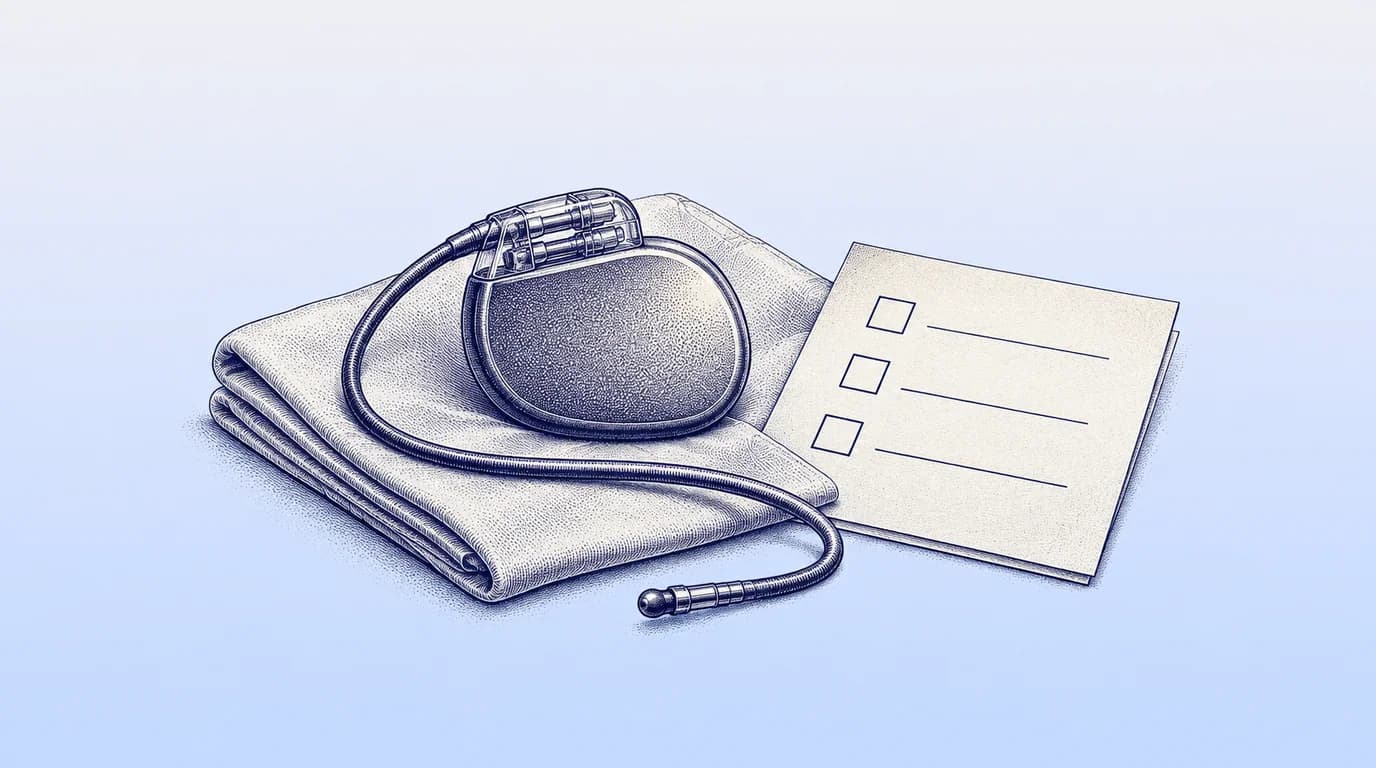
Nobody mentioned a pacemaker on the first call. The family did not think of it at the arrangement conference. The body is on the way to the crematory, and the operator is the last person who can catch it. Every cremation needs a clear answer to one question, recorded before the retort is loaded: is there anything implanted in this person that could explode, shock someone, or release radiation? This guide covers why it matters, what the law asks, and how to make the answer impossible to skip. It is general information, not legal or medical advice.
Why must implanted devices be removed before cremation?
Because the batteries in them can explode. In a survey published in the Journal of the Royal Society of Medicine in 2002, Gale and Mulley wrote to all 241 crematoria in the United Kingdom and had a 78% response. They found that about half of UK crematoria experience pacemaker explosions. Reported damage included door and brickwork damage, a cremator damaged beyond repair, and one explosion that injured staff. Only 5% of the staff who answered knew that implantable defibrillators can also explode.
The UK Medicines and Healthcare products Regulatory Agency said the same of defibrillators in a 2008 alert: they usually contain a lithium battery that may explode if exposed to high temperatures, so removal is necessary before cremation. The Cremation Association of North America’s Model Cremation Law, approved in 2017, says no human remains shall knowingly be cremated with a battery-operated or other potentially hazardous implant in place. Its explanation adds that deep brain stimulators, radioactive seeds and some dental work may need to be removed, and that firms should ask about all of a person’s treatments and check manufacturer recommendations.
What does the law say about implanted devices?
Most cremation statutes put the first duty on the person who signs the authorization: they declare whether there is a hazardous implant. Some then put a second duty on the funeral director. The table shows seven examples and the CANA model.
| Where | What the authorization or rule requires | Who must make sure it is removed | Source |
|---|---|---|---|
| Texas | The agent declares that, to their knowledge, there is no pacemaker or other hazardous implant | The agent, who must notify the funeral director and crematory. If the agent discloses a device, the funeral director must ensure removal before delivery | Health and Safety Code 716.052(a)(6), 716.154 |
| Illinois | A representation that the remains contain no pacemaker or other potentially hazardous implant | Treated as the authorizing agent’s representation | 410 ILCS 18/20(a)(1)(G), (N) |
| New York | A statement from a physician, coroner or medical examiner that the body contains no battery or power cell | The cemetery may refuse to cremate without the statement | Public Health Law 4202(1) |
| Ohio | The agent states whether they know of a hazardous device, including pacemakers, defibrillators and other mechanical or radioactive devices | The funeral home need not verify the agent’s statements unless it has actual knowledge otherwise | Revised Code 4717.24(A)(5), (D) |
| Minnesota | Certification that the body contains no implanted mechanical or radioactive device, such as a pacemaker | If the crematory finds one after delivery, a licensed mortician or physician removes it | Minnesota Statutes 149A.95, subdivisions 4 and 7 |
| Iowa | A representation that the remains contain no potentially hazardous material or implants | The crematory will not cremate when it knows of a pacemaker or hazardous implant | Iowa rule 481-900.10 |
| California | The Cemetery and Funeral Bureau’s consumer guide tells families the facility may remove prostheses, medical devices and implants before the process | Not stated in the guide | CFB consumer guide (2026) |
| CANA model law | A representation that there is no battery-powered implant or radioactive or other hazardous material | The agent is ultimately responsible. Once the agent discloses a device, the funeral director is responsible too, and liable with the agent if it is cremated | Model Cremation Law, Parts 4, 7 and 10 |
See the pacemaker check on a sample cremation case
Texas is the clearest on liability. Under section 716.154(d), an agent or funeral director who fails in these duties is liable in a civil action to the crematory for the damages that result. Even where your state’s form puts the declaration on the family, a crematory that loses a retort door will ask who delivered the body. For the rest of each state’s cremation rules, see the guides to Texas, Illinois, New York and Ohio.
Which devices should you ask about?
Ask about the device first and the diagnosis second. Families often know "he had a heart thing" but not its name. The table groups devices by the risk they carry.
| Device | Risk | What to do | Basis |
|---|---|---|---|
| Pacemaker | The battery can explode in the retort | Remove before delivery to the crematory | Texas 716.154; Gale and Mulley survey |
| Implantable cardioverter defibrillator (ICD) | Explosion in the retort, and a shock to the person removing it | Have it deactivated, or remove it intact with protection | MHRA alert, 2008 |
| Other battery-powered implants, such as a deep brain stimulator | The battery, as with a pacemaker | Ask, check the manufacturer’s guidance, and remove if advised | CANA model law explanation |
| Radioactive seeds or other radiation treatment | Radiation released into the crematory and the stack | Ask the treating hospital how long since treatment and whether it is safe | NRC; Health Physics Society; CANA |
| Joint replacements, pins, plates and other metal | Not an explosion risk in the sources read | Leave in place. The crematory separates metal after cremation | Minnesota 149A.95, subdivision 12 |
Minnesota’s statute shows how the last row is handled: after cremation, reasonable efforts are made to remove the noncombustible items, separate them from the cremated remains, and dispose of them lawfully, and the authorization asks the family for directions about them. Tell families this in plain words at the arrangement conference, along with what happens to jewelry and other belongings, which the personal effects guide covers.
What should you ask at the first call and the arrangement conference?
Ask twice. The first call often comes from a nurse or a tired relative at 2 AM, and the answer may be "I don’t know." That is acceptable on the first call. It is not acceptable at the crematory door. Add these questions to your first call intake checklist.
| Question | Why |
|---|---|
| Did they have a pacemaker or a defibrillator? | The two most common battery-powered implants |
| Any other implanted device with a battery, such as a nerve or brain stimulator or a pump? | Families rarely volunteer these |
| Did they have radiation seeds or radioactive treatment in the past year? | Decides whether to call the treating hospital |
| Which hospital or clinic followed the device? | Who can deactivate it, and who will want it back |
| Do you have the device card the patient carried? | Gives the maker and model |
| Was the device removed at the hospital or at an autopsy? | Prevents a search for a device that is gone |
| Would the family like the device returned, donated or disposed of? | Some families have a view, and it should be asked |
At the arrangement conference, read the implant line on the authorization aloud before the family signs it. A family member who signs a declaration they did not understand has not helped you. The arrangement checklist is the place to make that a habit.
Who removes the device, and how?
Who may remove it depends on your state. Minnesota section 149A.95, subdivision 7, says a device found after the crematory accepts the body must be removed by a licensed mortician or physician. Texas puts the duty to ensure removal on the funeral director once the agent discloses the device. If you are unsure who may do it in your state, ask your board before you need the answer.
Defibrillators need care before anyone cuts. The MHRA alert, addressed to clinicians and mortuary staff who remove ICDs after death, warns that cutting the heart lead can make the device sense noise and deliver a shock. It advises:
- Identify the maker and model first, from the device card, the records or an X-ray.
- Contact the clinic that followed the patient, or the nearest cardiac center, to have the device set permanently to a mode that delivers no shock, and record that it was done.
- If that is not possible, remove the device and its leads intact, wearing appropriate rubber gloves and boots, and do not cut the heart leads.
- Be careful with magnets. A magnet can stop shocks while it is in place, but separating it from the device may restore them.
- Package and label a removed device that was only disabled by a magnet, and never dispose of a defibrillator by incineration.
The alert is from the UK and dates from 2008, so treat it as a description of the hazard and check current guidance with the device’s manufacturer. Record who removed the device, when, and who witnessed it.
What about radioactive seeds and other radiation treatment?
Ask, then call the hospital. Some prostate cancer treatments leave small radioactive seeds in place permanently. A Health Physics Society expert answer from 2012 says iodine-125 has a half-life of 60 days, so after about 10 months the seeds have lost more than 95% of their activity. If a body is cremated while the seeds are still radioactive, the material may be dispersed in the cremation equipment and surrounding areas, and most of the iodine would leave through the stack.
The Nuclear Regulatory Commission’s page on burial of patients with permanent implants says the implants would not have to be removed, because permanent implants are not intended to be removed. It also notes that NCRP Report No. 37 sets precautions for cremation, including a limit on the total amount a single crematorium can safely handle each year. CANA’s model law says the treating hospital’s radiology department should be consulted to document the isotope’s half-life and the timeframe for safe cremation.
- Ask the family which hospital gave the treatment and roughly when.
- Call that hospital’s radiology department or radiation safety officer, and give them the date of death.
- Record what they told you, who said it, and when.
- Tell the crematory in writing before delivery, and let it decide whether to proceed.
What do you do with the device after it is removed?
Ask the family first, then pick one of three routes and record which.
| Route | How it works | What to record |
|---|---|---|
| Return to the manufacturer | Medtronic’s returns page says it will send a biohazard return kit, free when its prepaid USPS label is used, and its 2020 product performance report asks for explanted devices from non-clinical sources such as funeral homes | Maker, model, serial number if visible, the kit or tracking number |
| Donate for reuse abroad | NFDA describes the University of Michigan’s My Heart Your Heart program: funeral homes and crematories sign up online, receive free kits with prepaid labels, and donated pacemakers are tested, sterilized and sent abroad | The family’s consent, and the shipping record |
| Dispose of it | Follow your state’s medical waste rules. The MHRA alert says never to incinerate a defibrillator | The date and how it was disposed of |
CANA’s model law says pacemakers, defibrillators and other battery-powered implants should be removed and sanitized before return to the manufacturer or placement in the appropriate recycling container. Medtronic’s report, under the heading “How You Can Help,” urges physicians to return explanted products, and says it asks funeral homes for them too and takes responsibility for their storage and disposal.
How should you document the device and its removal?
Write down the question, the answer, and every step after it, on the case. If the crematory ever asks, the record should answer without anyone’s memory.
- The answer and its source. Yes, no or unknown, who gave it, and when: the caller, the hospital, the family at the arrangement.
- The device. Type, maker and model, from the card or the device itself.
- The removal. Who removed it, when, who witnessed it, and for a defibrillator, whether it was deactivated first.
- Where it went. Returned, donated or disposed of, with the tracking number.
- What the crematory was told. In writing, before delivery.
Treat the removal as a custody step like any other, as the chain of custody guide describes, and keep it where the next director will look, as audit-ready documents explains.
How FuneralHQ handles this
FuneralHQ’s first call sheet asks "Pacemaker?" on every call, and an unknown answer does not hold the call back. On a cremation case, the case board in case management shows the cremation as blocked until someone records whether there is a pacemaker or implanted device. If a device is recorded, a cremation date cannot be saved until its removal is recorded, there is no override, and each answer and removal shows who recorded it and when.
Common questions about implanted devices and cremation
Does a pacemaker really explode in a cremation?
It can. Gale and Mulley’s 2002 survey found that about half of UK crematoria experience pacemaker explosions, with damage to doors and brickwork and one explosion that injured staff. That is why statutes such as Texas section 716.154 bar a crematory from knowingly cremating a body with a pacemaker.
Who is responsible if a pacemaker is cremated?
In Texas, the authorizing agent or funeral director who failed in their duty is liable to the crematory for the resulting damages. Under CANA’s model law, once the agent discloses a device, the funeral director who delivers the body is liable along with the agent. Other states vary.
Does a hip or knee replacement have to come out?
None of the sources read for this guide requires it. Joint replacements and other metal are noncombustible, and Minnesota’s statute describes the crematory separating such items from the cremated remains after cremation and disposing of them lawfully, following the family’s directions on the authorization.
Do pacemakers have to be removed before burial?
The rules read here concern cremation. The NRC page says there appear to be no restrictions on burial of patients with permanent radioactive implants beyond preparing the body. Ask your state board about any burial rule for devices.
What if the family does not know whether there is a device?
Record "unknown" and keep asking. Check the hospital or hospice records, ask the physician’s office, and look for a device card among the person’s belongings. Do not deliver the body for cremation until the answer is yes or no.
Can a pacemaker be reused?
Not in the United States through the program described here. NFDA’s article says My Heart Your Heart tests and sterilizes donated pacemakers and ships them abroad for patients in participating countries. Ask the family before you donate anything.
Do we need the family’s permission to remove a device?
Removal before cremation is part of preparing the body safely, and the authorization is where the family declares the device. Explain on the form and in conversation that the device will be removed, and ask what they want done with it afterward.
Does a removed defibrillator still carry a charge?
It can. The MHRA alert says a device only temporarily disabled by a magnet may be able to shock again once the magnet is removed, so it should be packaged and labeled. Have a deactivated status confirmed by the follow-up clinic where you can.
The FuneralHQ advantage
Preneed, custody, and cemetery work in one system
FuneralHQ connects preneed, at-need case work, documents, payments, and QuickBooks Online. Chain of custody runs on signed, timestamped forms with QR and barcode scan checkpoints. Cemetery mapping, plot inventory, and deeds are included.
The walkthrough separates what ships today from what is in development, then tests FuneralHQ against one of your real workflows.
Challenge us with your workflowSources
- Public.Law: Texas Health and Safety Code section 716.154, pacemakers
- Public.Law: Texas Health and Safety Code section 716.052, cremation authorization form
- Illinois General Assembly: 410 ILCS 18/20, authorization to cremate
- New York State Senate: Public Health Law section 4202, cremated remains
- Ohio Laws and Administrative Rules: Revised Code section 4717.24, cremation authorization form
- Minnesota Office of the Revisor of Statutes: chapter 149A, including section 149A.95
- Iowa Administrative Code rule 481-900.10, cremation of human remains, via Cornell Legal Information Institute
- California Cemetery and Funeral Bureau: Consumer Guide to Funeral and Cemetery Purchases (2026)
- Cremation Association of North America: Model Cremation Law and Explanation (approved November 16, 2017)
- Gale CP, Mulley GP: Pacemaker explosions in crematoria, Journal of the Royal Society of Medicine (2002), via PubMed Central
- UK Medicines and Healthcare products Regulatory Agency: medical device alert on removing ICDs (2008)
- US Nuclear Regulatory Commission: burial of patients with permanent implants
- Health Physics Society: Ask the Experts, cremation and I-125 prostate implant seeds (2012)
- Medtronic: product returns and replacements
- Medtronic: Cardiac Rhythm and Heart Failure Product Performance Report, 2020 second edition
- National Funeral Directors Association: Program Offers New Life for Used Pacemakers
About the FuneralHQ Editorial Team
This guide was written by the FuneralHQ Editorial Team, the in-house team behind funeral home software used by independent firms to run cases, documents, payments, and QuickBooks sync in one record. Our editorial standards explain how we review product claims, outside sources, automation, updates, and corrections.